
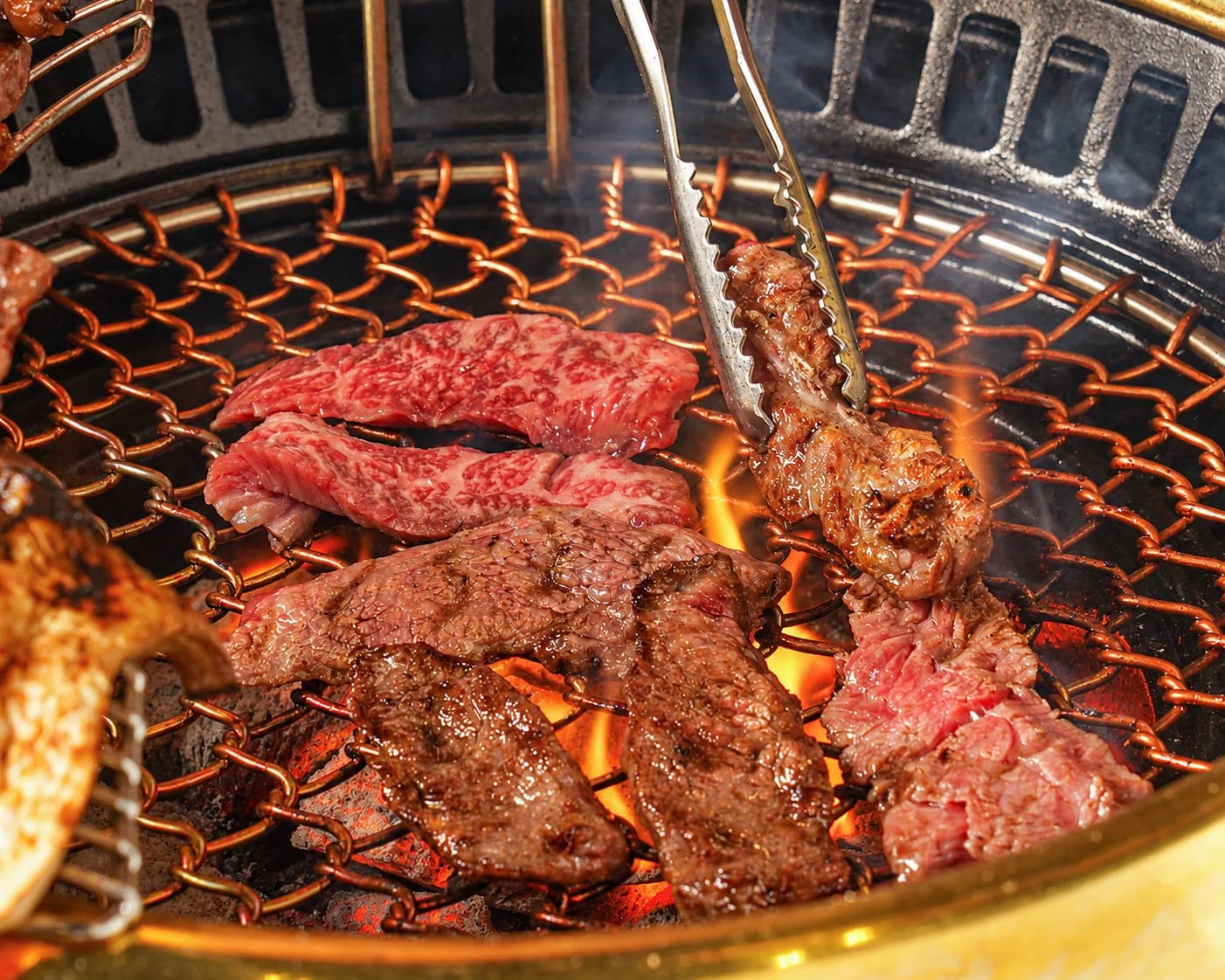
When you sit down for charcoal-grilled Korean BBQ in Myeongdong, the cooking method is part of the experience. Before the first piece of beef reaches the table, glowing charcoal establishes the heat that will shape its texture, aroma, and flavor.
For premium 1++ Hanwoo, the difference is particularly interesting. Carefully controlled heat can develop a beautifully browned exterior while allowing the beef's natural marbling and tenderness to remain central to the meal.
But does charcoal actually make Korean BBQ taste better? And why do premium Korean beef restaurants continue to use it when modern gas grills offer easier temperature control?
The answer involves cooking science, traditional Korean dining culture, and the skill required to prepare different cuts of beef.
At HANWOOJEONG, a premium Korean BBQ restaurant in Myeongdong, Seoul, real charcoal grilling and staff-assisted cooking bring these elements together in a dining setting inspired by Korean heritage.
What Makes Charcoal-Grilled Korean BBQ Different?
Charcoal-grilled Korean BBQ uses burning charcoal as the heat source beneath the cooking surface. Unlike gas burners, which generally offer direct control through adjustable knobs, charcoal produces heat through the combustion of solid fuel.
That distinction changes how the grill is managed.
A charcoal fire generates substantial radiant heat, which travels directly from the glowing coals toward the food. The hot grill surface also transfers energy through direct contact, while surrounding hot air contributes to the cooking process.
Together, these forms of heat allow beef to brown rapidly when the grill is properly prepared.
The result can be a satisfying contrast between a browned exterior and a tender interior. This is particularly desirable when cooking high-quality beef in small portions directly at the table.
However, using charcoal successfully requires attention. Heat varies depending on the condition of the coals, airflow, distance from the heat source, and arrangement of the meat.
Experienced grilling therefore involves more than placing beef on a hot surface. It requires knowing when to move, turn, or remove each piece.
Why Charcoal Remains Part of Traditional Korean BBQ
Grilling meat over burning fuel is a longstanding cooking practice in Korea, although modern Korean BBQ restaurants use different fuels, equipment, and service styles.
Charcoal remains associated with traditional Korean barbecue because it brings diners close to the cooking process. Guests can watch the meat brown, hear it sizzle, and enjoy the aroma as the meal develops.
The grill also provides a natural centerpiece for shared dining.
Rather than receiving individually plated steaks, guests can enjoy several cuts in succession, discovering differences in texture and flavor while sharing accompaniments around the table.
This approach is particularly well suited to Hanwoo, Korea's native premium beef.
For readers unfamiliar with the ingredient, our guide to what Hanwoo beef is and why it is valued in Korea explains its origins, characteristics, and place in Korean food culture.
Charcoal vs. Gas Korean BBQ: Does the Heat Source Affect Flavor?
One of the most common questions about Korean BBQ is whether charcoal produces noticeably better-tasting meat than gas.
The answer depends on the cooking conditions.
Charcoal can provide intense radiant heat and introduce a different grilling environment, but excellent browning is possible with both charcoal and gas. Neither fuel automatically guarantees better results.
To understand why, it helps to separate three important factors: surface browning, rendered fat, and smoke.
The Maillard Reaction: Where Grilled Beef Develops Flavor
When the surface of beef becomes sufficiently hot, amino compounds and reducing sugars participate in chemical reactions known collectively as the Maillard reaction.
These reactions contribute to the browned color and complex roasted aromas associated with grilled meat.
The Maillard reaction does not require charcoal specifically. It can occur when meat is cooked on a hot pan, gas grill, or charcoal grill.
What matters is achieving suitable surface conditions, including adequate heat and controlling excess moisture.
Charcoal grilling can be particularly effective because glowing coals provide strong radiant energy, helping the exposed meat surface brown while the grill itself remains hot.
For premium Hanwoo, careful browning creates contrast: a flavorful exterior surrounding an interior that retains its intended texture.
How Marbling and Rendered Fat Influence Flavor
Marbling refers to the small streaks of intramuscular fat distributed throughout beef.
As Hanwoo cooks, some of this fat softens and renders, influencing the meat's perceived richness, lubrication, aroma, and mouthfeel.
A small amount of fat may also drip onto the heated grill or coals beneath it. When this happens, vaporized compounds and smoke can contribute additional grilled aromas.
This is one reason the cooking method matters, even when the beef itself has not been marinated or heavily seasoned.
However, more smoke is not always better.
Excessive flare-ups can burn the meat's surface, create unpleasant flavors, and introduce undesirable combustion compounds. Skilled grilling aims to develop appetizing browning without allowing uncontrolled flames to overwhelm the beef.
Is Charcoal Always Better Than Gas?
Not necessarily.
Gas grills offer practical advantages, including fast ignition, adjustable heat, and generally predictable temperature control.
A well-designed gas grill can also produce excellent searing and browning. Smoke-related flavors may develop when rendered fat reaches sufficiently hot surfaces.
Charcoal offers a different set of advantages, particularly its strong radiant heat and the distinctive experience of cooking over glowing coals.
Ultimately, the quality of the beef, grill design, heat management, and cooking technique all influence the final result.
For guests seeking premium Korean BBQ, the more useful question is not simply whether charcoal is better, but whether the restaurant understands how to use its chosen grilling method to bring out the character of the meat.
Why Charcoal Grilling Works Well With Premium 1++ Hanwoo
Hanwoo is prized for the variety of eating characteristics found across its different cuts. Some are exceptionally tender and delicate, while others offer substantial marbling, a satisfying chew, or a pronounced beef flavor.
The 1++ designation represents the highest category in Korea's official beef quality grading system.
That classification considers factors including intramuscular fat, meat color, fat color, texture, and maturity.
Importantly, the grade describes beef quality; it does not determine the ideal cooking method or guarantee that every cut will have the same tenderness or flavor.
Our complete guide to understanding 1++ Hanwoo grading explains the grading system in greater detail.
The Relationship Between Heat and Hanwoo Marbling
When cooking richly marbled beef, heat management becomes especially important.
If the cooking surface is insufficiently heated, the exterior may brown slowly, and the meat can spend more time cooking before the desired surface develops.
If the heat is excessively intense, the exterior may darken or burn before the inside reaches the intended doneness.
The goal is balance.
Controlled charcoal grilling allows the cook to use sufficient heat for browning while adjusting cooking time and placement according to the cut's thickness, marbling, and structure.
Richer cuts may benefit from careful monitoring as fat renders, while leaner cuts require particular attention to avoid becoming dry or firm.
There is no single ideal grilling time for every piece of Hanwoo.
Its thickness, starting temperature, shape, and the actual heat reaching the surface all affect how it cooks.
This is why professional tableside grilling can be particularly valuable when guests order several premium cuts in the same meal.
How Different Hanwoo Cuts Respond to Charcoal Grilling
Understanding the differences between beef cuts can make a charcoal-grilled Hanwoo tasting considerably more rewarding.
HANWOOJEONG's menu features seven premium Hanwoo cuts, each offering a different combination of marbling, tenderness, richness, and texture.
Ribeye (등심): Balanced Marbling and Rich Flavor
Ribeye is an excellent introduction to premium Hanwoo.
Its balance of intramuscular fat and beef flavor makes it suitable for developing a browned exterior while maintaining a juicy interior.
On a charcoal grill, the goal is to encourage even browning without excessively rendering the fat or cooking the meat beyond the guest's preference.
Ribeye also makes a useful reference point when comparing leaner cuts with more heavily marbled selections.
Tenderloin (안심): Delicate Texture Requires Precision
Tenderloin is valued primarily for its exceptional tenderness.
Compared with heavily marbled cuts, it is typically leaner and has a more delicate flavor.
Because it contains less intramuscular fat, extended exposure to high heat may reduce the soft, tender qualities that make the cut appealing.
Precise timing is especially important. Gentle handling and controlled grilling help preserve tenderloin's characteristic texture.
Top Blade (부채살): Pronounced Beef Flavor and Texture
Top blade is appreciated for its beef-forward flavor and distinctive muscle structure.
Its texture can vary depending on how the central connective tissue is trimmed and how the meat is sliced.
Charcoal grilling can create a flavorful browned exterior, while appropriate slicing and cooking help manage the cut's natural firmness.
For guests who enjoy a more substantial beef character rather than softness alone, top blade offers an interesting contrast.
Short Rib (갈비살): Deeply Savory and Satisfying
Boneless short rib meat is known for its pronounced beef flavor and satisfying chew.
Its combination of fat, connective tissue, and muscle fibers gives it a different eating character from tenderloin or ribeye.
When grilling short rib, attention to piece size, thickness, and heat helps develop browning while maintaining a pleasant texture.
The result is a cut that rewards diners who enjoy a richer, more substantial bite.
Short Plate (업진살): Richness With a Distinctive Bite
Short plate comes from the lower rib and belly region of the animal and is often appreciated for its pronounced richness.
Depending on the specific portion and trimming, the meat can combine significant fat with a pleasantly chewy structure.
Charcoal grilling requires careful heat control as the fat begins to render.
Because rich cuts can brown quickly, the cook needs to watch the surface closely and prevent excessive flare-ups.
Chuck Flap Tail (살치살): Rich Marbling and Buttery Texture
Chuck flap tail is one of the most sought-after cuts for guests who enjoy highly marbled Hanwoo.
Its fat distribution contributes to a luxurious mouthfeel, while the underlying muscle provides characteristic beef flavor.
The challenge is preserving that richness without allowing the meat to become overly greasy or excessively cooked.
With carefully controlled charcoal heat, chuck flap tail can develop appealing browning while retaining its soft, succulent character.
Ribeye Cap (새우살): A Rich and Tender Premium Cut
Ribeye cap is prized for its tenderness, marbling, and concentrated beef flavor.
Its delicate structure and richness make it particularly enjoyable when cooked with attention to timing and heat exposure.
Because portions may be relatively small or thin, the transition from properly cooked to overdone can happen quickly.
Careful grilling helps preserve the balance of tenderness, rendered fat, and browned flavor that makes this cut distinctive.
Each of these seven cuts responds differently to heat, even within the same beef quality grade.
For a more detailed comparison of their textures, marbling, and recommended tasting experience, explore our Hanwoo cuts guide covering ribeye, ribeye cap, chuck flap tail, and other premium selections.
Why Staff-Grilled Korean BBQ Makes a Difference
Part of Korean BBQ's appeal is the interaction between the diner and the grill.
At some restaurants, guests are expected to cook their own meat. At others, staff handle the grilling process and serve the beef as it becomes ready.
Neither approach is inherently superior, but staff-assisted grilling offers practical advantages when the menu centers on premium Hanwoo.
Cooking several cuts at one table requires continuous attention.
A cook may need to adjust the placement of one piece while turning another, remove a leaner cut before it becomes overdone, or manage rendered fat from a richer selection.
Guests unfamiliar with Korean beef may find these differences difficult to judge.
Professional assistance allows them to focus on tasting rather than constantly monitoring the grill.
It can also create opportunities to explain the differences between cuts, suggest a tasting order, and introduce Korean sauces or banchan.
At HANWOOJEONG, staff-assisted charcoal grilling forms part of the restaurant's premium dining approach.
Visitors can appreciate the cooking process while enjoying the convenience of having the beef prepared at the table.
For travelers planning their first restaurant experience, our Myeongdong Korean BBQ guide for first-time visitors offers additional information about menus, etiquette, and ordering.
Charcoal Grilling and Korean Dining Heritage
Korean BBQ is not defined by the grill alone.
The shared table, the sequence of cooking and eating, and the presence of multiple accompaniments contribute just as much to the experience.
At a traditional-style Korean barbecue meal, diners do not necessarily eat one completed dish from beginning to end.
Instead, freshly grilled meat arrives in portions. Each bite can be enjoyed differently, with salt, fermented sauces, pickled vegetables, kimchi, or other side dishes.
This allows a meal to develop naturally through contrasts of richness, acidity, texture, and flavor.
Charcoal grilling provides a particularly distinctive backdrop to that experience because the cooking takes place visibly over a live heat source.
Yet traditional Korean dining is not limited to any one fuel. Modern Korean barbecue includes charcoal, gas, and other grilling systems, each with its own advantages.
What matters most is how the ingredients, preparation, service, and atmosphere come together.
At HANWOOJEONG, that approach extends to the surroundings.
The restaurant's hanok-inspired interior draws on traditional Korean architectural details, including warm wood tones and heritage-influenced design elements.
Rather than recreating a historical building, the setting interprets Korean aesthetics within a contemporary premium dining environment.
The result is a restaurant where the grill, the meat, and the atmosphere all contribute to a coherent Korean dining experience.
Experience Charcoal-Grilled Hanwoo at HANWOOJEONG in Myeongdong
For travelers searching for charcoal-grilled Korean BBQ in Myeongdong, HANWOOJEONG offers an experience centered on premium 1++ Hanwoo.
The restaurant combines carefully selected Korean beef, in-house meat preparation, real charcoal grilling, and staff-assisted tableside service.
The menu allows diners to order individual cuts or explore several selections through curated Hanwoo sets.
For example, guests can experience the balance of ribeye, the savory character of short rib, and the richer textures of chuck flap tail and ribeye cap during the same meal.
This variety makes it easier to appreciate how different muscles respond to grilling and why Hanwoo is not defined by one level of marbling or tenderness.
You can explore the available cuts and tasting combinations on the official HANWOOJEONG Korean BBQ menu.
The restaurant also welcomes international diners with English-language information and multilingual assistance, subject to staff availability.
Combined with a hanok-inspired interior and traditional Korean accompaniments, the dining experience is designed to feel approachable without losing its focus on premium ingredients.
For visitors comparing restaurants, our guide to where to eat premium Hanwoo in Myeongdong explains what to consider when choosing a Korean beef restaurant in Seoul.
Where Is HANWOOJEONG Located?
HANWOOJEONG is located at:
3F, 44 Myeongdong 3-gil, Jung-gu, Seoul, South Korea
The restaurant is approximately a one-minute walk from Euljiro-1-ga Station, Exit 5, on Seoul Subway Line 2.
Its central location makes it convenient for visitors staying in Myeongdong or exploring the surrounding shopping and sightseeing districts.
For further directions and current opening hours, see our Myeongdong restaurant location and visitor information.
How to Enjoy Charcoal-Grilled Hanwoo for the First Time
If you are new to premium Korean beef, the best approach is to focus on the differences between cuts rather than trying to identify one universally superior selection.
Begin by ordering a combination of leaner and more heavily marbled beef.
Tenderloin offers a delicate starting point, while ribeye provides a balanced introduction to marbling and beef flavor.
Short rib or top blade can introduce a firmer, more savory character. Richer cuts such as chuck flap tail and ribeye cap provide a contrasting experience later in the meal.
The exact sequence can be adjusted according to your preferences and the restaurant's recommendations.
Taste the Beef Before Adding Strong Sauces
When the first pieces arrive, consider trying them with a small amount of salt.
This allows you to appreciate the beef's natural flavor, fat distribution, and grilled aroma before introducing more assertive seasonings.
Afterward, experiment with wasabi, ssamjang, or other available accompaniments.
The purpose of pairing is not to hide the flavor of premium Hanwoo, but to explore how different combinations change each bite.
Use Banchan to Balance Richness
Korean BBQ is traditionally accompanied by banchan, a selection of side dishes that may include vegetables, kimchi, pickles, and other preparations.
Acidic or refreshing accompaniments can provide contrast between bites of richly marbled beef.
Rather than eating all the side dishes separately, try them throughout the meal.
For more pairing ideas, our Korean BBQ sauces and banchan guide explains how different flavors complement premium Hanwoo.
Communicate Your Preferred Doneness
If the staff is preparing the meat, let them know whether you prefer your beef more or less cooked.
Some cuts benefit from particular preparation methods, and individual preferences vary.
Asking questions is part of enjoying premium Korean BBQ, especially when tasting Hanwoo for the first time.
A thoughtfully paced meal allows you to appreciate each cut while it is freshly grilled, rather than leaving multiple portions on the table to cool.
Frequently Asked Questions
-
Charcoal is not automatically better than gas, but it creates a different grilling environment. It provides strong radiant heat and can contribute distinctive grilling aromas. Gas offers convenient temperature control and can also produce excellent browning. The quality of the beef, grill design, heat management, and cooking technique ultimately determine the result. Many premium Korean BBQ restaurants favor charcoal for its cooking characteristics and traditional appeal.
-
Charcoal grilling can influence the aroma and flavor of Korean beef through the combination of radiant heat, surface browning, and smoke-related compounds. As fat renders and drips onto hot surfaces, additional aromas may develop. However, the result varies with cooking time, grill design, fuel characteristics, and heat control. Charcoal alone does not guarantee a stronger or better flavor.
-
The main difference is the heat source. Charcoal Korean BBQ uses burning charcoal beneath the grill, while many other Korean BBQ restaurants use gas or electric cooking systems. Both methods can prepare high-quality meat. Charcoal introduces different heat-management requirements and a traditional live-fire atmosphere, while gas and electric systems generally provide more straightforward temperature control.
-
Tableside grilling allows guests to eat Hanwoo shortly after cooking, while the meat is still hot. It also makes it possible to taste multiple cuts gradually instead of serving every portion simultaneously. Korean BBQ emphasizes shared dining, where guests experience the cooking process and enjoy meat with different accompaniments throughout the meal.
-
Yes. Premium 1++ Hanwoo can be well suited to charcoal grilling when the heat is carefully controlled. Its marbling can contribute richness and tenderness, while sufficient surface heat creates appealing browning. However, different cuts require different cooking approaches. Lean tenderloin, richly marbled ribeye cap, and more substantial short rib should not necessarily be cooked in the same way.
-
HANWOOJEONG serves premium 1++ Hanwoo grilled over real charcoal in Myeongdong, Seoul. Located at 3F, 44 Myeongdong 3-gil, the restaurant offers staff-assisted tableside grilling and a hanok-inspired dining environment. Guests can choose individual Hanwoo cuts or curated sets designed to introduce different beef textures and flavors.
Discover the Difference at HANWOOJEONG
Charcoal grilling is not simply a traditional detail. It is a cooking method that requires careful heat management and offers a distinctive way to experience premium Korean beef.
When combined with thoughtfully selected Hanwoo, skilled tableside grilling, and complementary Korean dishes, it allows guests to explore the differences between beef cuts in a more deliberate way.
At HANWOOJEONG, we bring these elements together in the heart of Myeongdong, where Korean dining heritage meets contemporary hospitality.
Whether you are discovering Hanwoo for the first time or returning to explore its different cuts, we invite you to experience premium 1++ Korean beef prepared over real charcoal.
Reserve your table at HANWOOJEONG in Myeongdong and discover a more considered approach to Korean BBQ.
